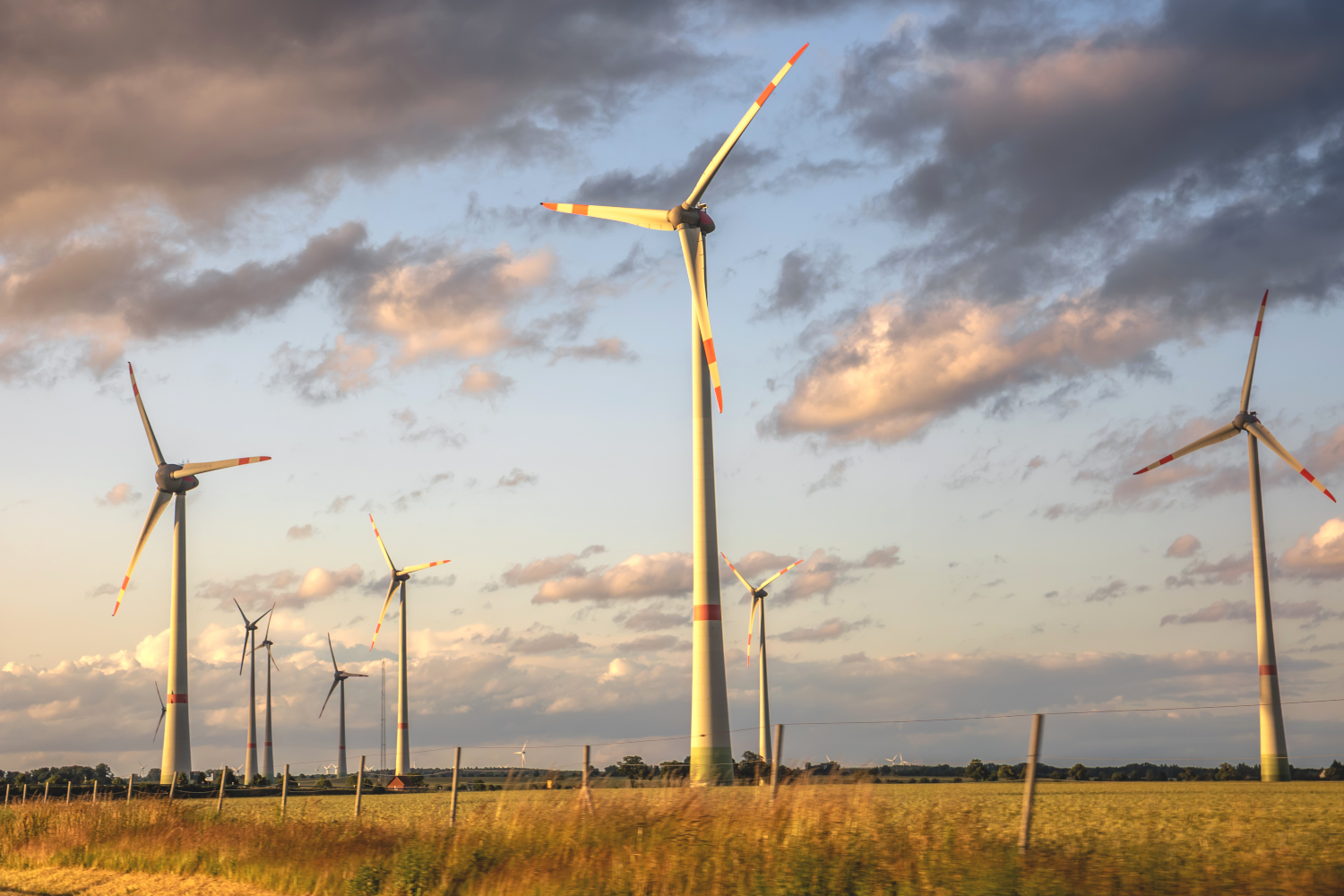
The successful financing of wind power projects in West Jutland is further driving up the share price of Ringkjøbing Landbobank. (Photo: Magnific.com, pvproductions)
Does Ringkøbing ring a bell? Probably not. The small town on Denmark's west coast is far from any hustle and bustle. That one of Europe's most profitable regional banks operates from here might therefore be quite surprising, but on the other hand, it is the result of 140 years of consistently implemented strategy.
In this country, Ringkjøbing Landbobank, which is listed on Nasdaq Copenhagen, is hardly known. But why has the stock been held by many investors from the north for years?
Key information about the Ringkjøbing Landbobank share
- The Danish Ringkjøbing Landbobank (RILBA) is shining in 2026 with a strong return on equity of 22.4 percent.
- A key success factor is consistent specialisation in project developers within the wind power sector.
- Shareholders benefit from share buybacks in addition to dividends; the new programme has just been launched.
A bank with clear ideas
Founded in 1886 as an agricultural bank for the farmers of West Jutland, Ringkjøbing Landbobank has always remained true to its roots, while also embracing change. Today, the institution primarily serves three client groups: wealthy private banking clients, regional medium-sized enterprises, and – its unique selling proposition – project developers in the wind power sector.
The latter is primarily due to the geographical location. West Jutland is considered the centre of the Danish wind power industry. Those who have been working here for decades understand the characteristics of relevant projects in a way that a competitor from Copenhagen or elsewhere cannot simply acquire. The expertise built up in the wind power business and the resulting (local) customer loyalty of Ringkjøbing Landbobank are unlikely to be easily challenged.
What the figures reveal about the strategy
In 2025, Ringkjøbing Landbobank reported a net profit of just over DKK 2.313 billion (approximately EUR 310 million). While a solid figure in itself, it was only marginally higher than the previous year's. From an investor's perspective, however, the return on equity – the profit the bank generates from the capital entrusted to it – should be more exciting.
With a figure of 22.4 per cent most recently, Ringkjøbing Landbobank certainly impressed in this regard. By way of comparison, the European banking average ranges between 10 and 13 per cent. This means that the Danes generate almost twice as much from every euro of equity capital invested as their competitors.
The first quarter of 2026 also delivered pleasing results with a core earnings of DKK 1.049 billion (around EUR 140 million), a net profit of DKK 585 million (just under EUR 78.5 million) and double-digit growth rates in both the loan portfolio and deposits.
However, the so-called cost-income ratio is particularly revealing, indicating how much a bank has to spend on its own operations for every euro earned. The Ringkjøbing Landbobank's figure was recently 25.5 percent, meaning that each euro earned generated a good 74 cents in profit. Many European banks have figures in the range of 55 to 70 percent in this regard, meaning they pay a far larger portion of their income for things like administration, branch networks, and staff.
Quality comes at a price
That investors are willing to pay a certain premium for Ringkjøbing Landbobank is shown, among other things, by the P/E ratio, which at just over 16 currently is no bargain compared to its peer group.
In return, however, shareholders not only benefit from a profitable business model and substantial returns on capital, but also enjoy two further advantages. Firstly, in March the bank paid a dividend of 12 DKK (approximately 1.60 euros) per share. Far more interesting, however, are the extensive share buy-backs.
The Ringkjøbing Landbobank only concluded a corresponding programme worth DKK 500 million in May. Shortly after, the next one already started, with a value of another DKK 400 million.
Attachment to one's homeland as an Achilles' heel
The focus that makes Ringkjøbing Landbobank so profitable is also its greatest weakness. The financial institution's business is concentrated in West and North Jutland – a region that is stable but leaves little room for manoeuvre if the economic situation there deteriorates. Should, for example, the expansion of wind power in Denmark falter, whether due to political shifts or a sustained decline in energy prices, a significant portion of the loan portfolio would be directly affected.
Ringkjøbing Landbobank: Conservative, but not without risk
With 140 years of business experience now behind it, Ringkjøbing Landbobank has certainly seen a lot. Although simply being on the market for a long time is certainly no guarantee of future success, the institution is likely well-positioned to weather temporary turbulence, not least thanks to its sound financial figures.
Investors should primarily see Ringkjøbing Landbobank as a European banking stock that, despite potential vulnerabilities – keywords being the future of wind power and interest rate levels – can represent a legitimate alternative or addition to the usual suspects in the financial sector.
Disclaimer:
No investment advice. No solicitation to buy or sell securities.
The contribution Ringkjøbing Landbobank Share: Unassuming performer from Denmark appeared first ftd.de.